
Archive and Highlight Cut After a Live Stream
Listen to this article5:05
The job does not end when the stream ends. Media7 in Baku locks a local record, a named archive and a next-day highlight cut on the same plan.
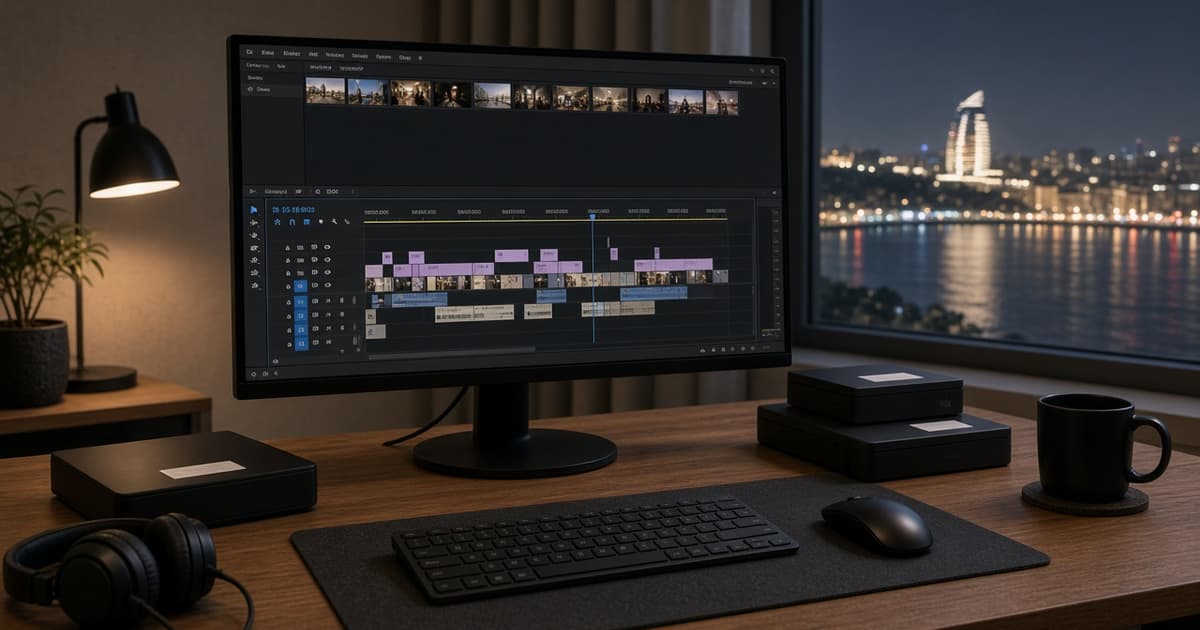
When the stream ends the material must remain
Even after live viewers leave, a brand still wants a social cut the next day, an internal replay and a sponsor report. In Baku, Media7 writes that need into the brief before show day. Without a local record, a platform drop kills the material too. With a record, the event remains.
Archive and highlight are not the same file. Archive is the full, named, as-clean-as-possible programme output. Highlight is a short, message-led, platform-ready cut.
What to record: programme and ISO
Minimum insurance is a local recording of the programme output: picture from the switcher, clean audio, seated graphics. Media7 treats this as a main layer on live stream day, not as a spare. Camera ISOs are recorded when possible so a wrong cut can be rebuilt later.
ISOs need space and stretch the next day. So they are written in the brief, not left as “maybe it will stay”. Copies in two places: a local disk and a spare pulled at once. Trusting one SSD is not an archive.
Naming and metadata
Folder names should carry date window, event name, language and version. Media7 avoids files called final2_new. Programme master, ISO, graphics pack and rehearsal stream stay apart. Rehearsal must not mix into the master.
Metadata holds a short note on platform, duration, speaker list and approval status. A year later “which panel was this” is answered from that note. If naming does not drift, the archive is findable.
What a highlight cut is
A highlight is not a shortened full replay. It is a short story for the next day: opening, core message, applause or a milestone, CTA. Media7 locks duration in the brief so a “put everything in” request does not turn the cut back into the whole air.
Audio and name graphics must stay correct in the highlight too. Laying music over a wrong name is not a fix. That is why audio-graphics discipline on show day also makes the later cut cheaper.
Rights and people in frame
Archive and highlight should stay inside the same consent circle. Media7 does not invent a statute. The brief closes at a high level whose face and voice may go to social the next day. A closed meeting’s full archive can stay internal while a public highlight is cut separately.
Music uses the same gate. A track that played in the hall is not automatically a social licence. When in doubt that passage is cut from the highlight or replaced with licensed bed music.
Next-day flow
Media7 reads the next day like this: master is checked, selected moments are marked, a short cut is built with even colour and audio, the client gets a first view, one revision round is closed. Faster than a full video production edit, but not as rushed as “leave the air as it was”.
9:16 and 16:9 come from the same decision. A separate story is not invented for each format; the crop window changes. If subtitles are needed, the talk stays inside the language in the brief.
Delivery pack
Delivery usually holds a programme master, a highlight, a social cut and a short written note: which moments, which language, which use. Media7 does not dump every ISO on the client if there is no need. ISOs stay in the archive, they are not daily posts.
Sponsors and an internal team may want different packs. That is a two-line table in the brief, not a later surprise.
Which moments are chosen
Moments for a highlight follow the message in the brief, not only applause. Opening, a key speaker, a milestone, a short CTA. Media7 holds a “put everything in” request behind a duration gate. A long cut is not posted the next day; it stays in the archive.
The choice goes into a written note: timecode, reason, language. That note keeps the revision round short. If the client wants a new moment, it is written into the same table, not lost in chat. Audio and name graphics must stay correct on the chosen second too.
The record lives in two places; the cut is built from the master. The master is not deleted. In Baku, Media7 closes a stream as material that still works the next day. That is not an extra show; it is the second half of the same plan.
Next step
Write in advance what is needed after the event: archive only, next-day highlight, or both. Media7 puts record, naming and cut rhythm on the plan. For scope use the price calculator or contact. The Baku team closes a stream as material that still works the next day, not as an event that vanished when the air ended.